
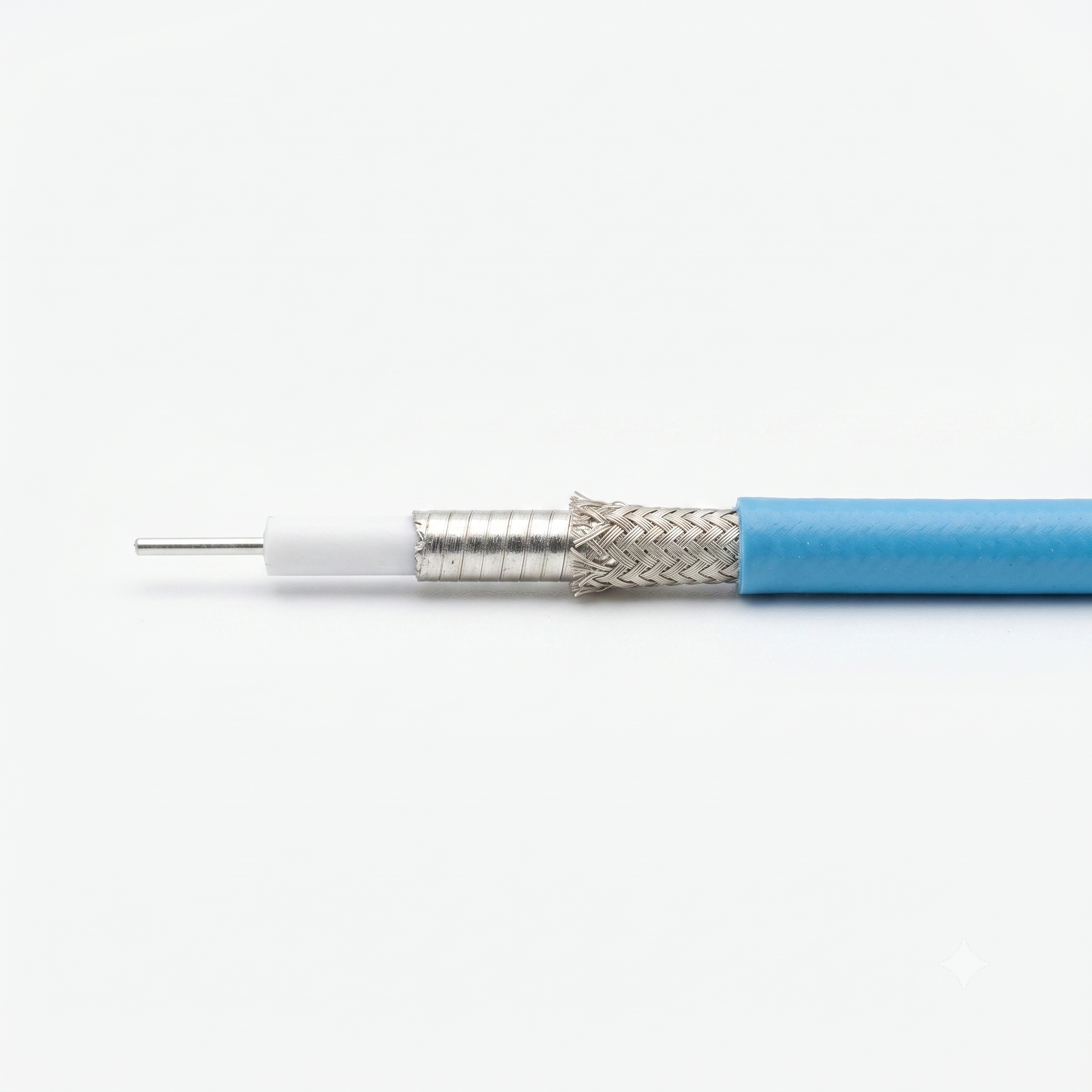
Ultra-Low-Loss Phase-Stable Microwave Coaxial Cable
Ultra-low-loss phase-stable microwave coaxial cable is designed for RF, radar, electronic warfare, navigation, communication, tracking, and precision microwave test systems requiring low attenuation, high shielding, stable phase performance, and reliable operation across wide frequency ranges. This cable family uses silver-plated copper conductor, microporous PTFE insulation, wrapped and braided outer conductor structures, and PFA jacket, with representative model options supporting up to 18GHz, 20GHz, 26.5GHz, 40GHz, and 60GHz.
Phase-Stable Cable
Up to 60GHz Options
Microporous PTFE + PFA
Overview
Ultra-Low-Loss Phase-Stable Microwave Coaxial Cable is designed for RF, radar, electronic warfare, navigation, tracking, communication, and precision microwave test systems where low attenuation, stable phase performance, and high shielding are critical.
This cable family uses a silver-plated copper conductor, microporous PTFE insulation, wrapped outer conductor, braided outer conductor, and PFA jacket. It is suitable for low-loss microwave transmission, precision phase transmission, RF interconnects, and microwave test applications requiring stable amplitude and phase performance under bending and temperature variation.
This page is intended for product selection. Exact specifications should be confirmed by frequency range, attenuation target, phase stability requirement, cable diameter, bending condition, connector requirement, installation environment, and project standard before ordering.
Series Options
The table below helps buyers compare representative model options before reviewing detailed RF performance data or cable drawings.
| Model | Product Positioning | Typical Selection Scenario |
|---|---|---|
| HY3506 | Highest-frequency representative option, up to 60GHz | For broadband microwave systems requiring very wide frequency coverage and compact cable diameter. |
| HY3507 | 40GHz phase-stable microwave coaxial cable | For DC-40GHz microwave systems requiring stable phase performance and lower attenuation than smaller cable options. |
| HY3449 | 26.5GHz low-loss phase-stable coaxial cable | For RF and microwave interconnects requiring balanced cable size, loss, and phase stability. |
| HY3450 | 20GHz low-loss microwave coaxial cable | For lower-loss transmission where larger cable diameter is acceptable. |
| HY3508 | 18GHz ultra-low-loss microwave coaxial cable | For applications prioritizing the lowest representative attenuation within the listed 18GHz model range. |
| BYC Custom | Custom phase-stable microwave coaxial cable assembly | For projects requiring custom cable length, connectors, attenuation, phase stability, jacket color, test data, or RF documentation. |
Features
Wide Frequency Range
Representative model options support up to 18GHz, 20GHz, 26.5GHz, 40GHz, and 60GHz depending on selected cable size and construction.
Ultra-Low Attenuation
Designed for low-loss RF and microwave transmission, with representative attenuation as low as approximately 0.65dB/m at 18GHz depending on selected model.
Phase-Stable Performance
Designed to support stable phase performance under temperature variation and bending conditions for precision microwave transmission.
High Shielding Performance
Wrapped and braided outer conductor structures support strong shielding performance for RF, microwave, and electronic systems.
Microporous PTFE Insulation
Microporous PTFE insulation helps reduce dielectric loss and supports high-frequency microwave signal performance.
Flexible Bending Stability
Designed for repeated bending with stable loss, VSWR, and phase performance in demanding RF cable routing applications.
Construction & Materials
This microwave coaxial cable uses a multi-layer RF construction designed for low loss, high shielding, and stable phase performance. Final selection should be based on operating frequency, attenuation requirement, bending condition, connector interface, and installation environment.
Construction Options
| Component | Available Options | Selection Notes |
|---|---|---|
| Inner Conductor | Silver-plated copper single wire | Supports stable RF conductivity and microwave signal transmission performance. |
| Insulation | Microporous PTFE insulation | Helps reduce dielectric loss and support low-attenuation microwave transmission. |
| Wrapped Outer Conductor | Wrapped outer conductor layer | Supports shielding, RF stability, and phase performance. |
| Braided Outer Conductor | Braided outer conductor layer | Improves shielding effectiveness, mechanical protection, and RF performance stability. |
| Outer Jacket | PFA jacket | Provides high-temperature resistance, chemical resistance, and environmental protection. |
| Packaging | Coiled or reel packaging | Packaging can be selected according to cable length, handling, and delivery requirements. |
| Custom Assembly | Connectorized cable assembly support can be reviewed | Connector type, length, phase matching, and test requirements should be confirmed by project specification. |
Construction Differences
| Model | Frequency Focus | Confirmed Diameter Data | When to Choose |
|---|---|---|---|
| HY3506 | Up to 60GHz | Inner conductor 0.50mm; insulation 1.40mm; shield OD 2.00mm max; jacket OD 2.30mm max. | Choose when the highest listed frequency range is required in a compact cable. |
| HY3507 | Up to 40GHz | Inner conductor 0.90mm; insulation 2.45mm; shield OD 3.10mm max; jacket OD 3.68mm max. | Choose for DC-40GHz microwave systems requiring phase stability and lower loss than smaller cables. |
| HY3449 | Up to 26.5GHz | Inner conductor 1.40mm; insulation 3.85mm; shield OD 4.42mm max; jacket OD 4.90mm max. | Choose when balancing low loss, size, and microwave transmission performance up to 26.5GHz. |
| HY3450 | Up to 20GHz | Inner conductor 2.10mm; insulation 5.75mm; shield OD 6.68mm max; jacket OD 7.48mm max. | Choose when lower attenuation is more important than compact cable size. |
| HY3508 | Up to 18GHz | Inner conductor 2.40mm; insulation 6.45mm; shield OD 7.25mm max; jacket OD 8.20mm max. | Choose for lowest representative attenuation in the listed 18GHz model options. |
Specifications
The specifications below are intended for preliminary product selection. Final values should be confirmed according to selected model, frequency range, attenuation target, phase stability requirement, cable diameter, bending condition, connector interface, and project standard.
| Product Family | Ultra-Low-Loss Phase-Stable Microwave Coaxial Cable |
|---|---|
| Application Frequency | Common application range includes DC-40GHz. Representative model options support up to 18GHz, 20GHz, 26.5GHz, 40GHz, and 60GHz depending on selected type. |
| Typical Applications | RF systems, communication systems, tracking systems, warning systems, electronic warfare, navigation, low-loss precision phase transmission, and microwave test systems |
| Inner Conductor | Silver-plated copper single wire |
| Insulation | Microporous PTFE insulation |
| Outer Conductor | Wrapped outer conductor and braided outer conductor structure |
| Outer Jacket | PFA jacket |
| Velocity of Propagation | 82% or 83% nominal depending on selected model |
| VSWR | <1.35 at 18GHz, representative product feature |
| Shielding | High-shielding design; representative shielding attenuation can be less than -100dB depending on construction and test condition. |
| Operating Temperature | -65°C to +200°C (-85°F to +392°F), representative product feature |
| Temperature Phase Stability | HY3506: ≤800ppm from -55°C to +85°C (-67°F to +185°F). Other listed models: ≤650ppm from -55°C to +85°C (-67°F to +185°F). |
| Bending Phase Stability | ≤3° at 10GHz, representative listed value |
| Packaging | Coiled or reel packaging |
| Customization | Available based on cable length, connector type, frequency range, phase stability, attenuation, jacket color, testing, and documentation requirements. |
For accurate quotation, please provide the required frequency range, attenuation target, phase stability requirement, cable length, connector type, bending condition, operating environment, and applicable drawings or RF test requirements.
Representative Model Comparison
| Model | Max Frequency | Velocity | Jacket OD | Temp. Phase Stability | Bend Phase Stability |
|---|---|---|---|---|---|
| HY3506 | 60GHz | 82% | 2.30mm max | ≤800ppm, -55°C to +85°C (-67°F to +185°F) | ≤3° at 10GHz |
| HY3507 | 40GHz | 83% | 3.68mm max | ≤650ppm, -55°C to +85°C (-67°F to +185°F) | ≤3° at 10GHz |
| HY3449 | 26.5GHz | 83% | 4.90mm max | ≤650ppm, -55°C to +85°C (-67°F to +185°F) | ≤3° at 10GHz |
| HY3450 | 20GHz | 83% | 7.48mm max | ≤650ppm, -55°C to +85°C (-67°F to +185°F) | ≤3° at 10GHz |
| HY3508 | 18GHz | 83% | 8.20mm max | ≤650ppm, -55°C to +85°C (-67°F to +185°F) | ≤3° at 10GHz |
Representative Attenuation Data
| Model | 2GHz | 4GHz | 8GHz | 10GHz | 18GHz |
|---|---|---|---|---|---|
| HY3506 | ≤0.90dB/m | ≤1.29dB/m | ≤1.86dB/m | ≤2.09dB/m | ≤2.87dB/m |
| HY3507 | ≤0.53dB/m | ≤0.75dB/m | ≤1.08dB/m | ≤1.21dB/m | ≤1.66dB/m |
| HY3449 | ≤0.34dB/m | ≤0.49dB/m | ≤0.70dB/m | ≤0.78dB/m | ≤1.06dB/m |
| HY3450 | ≤0.22dB/m | ≤0.32dB/m | ≤0.44dB/m | ≤0.50dB/m | ≤0.68dB/m |
| HY3508 | ≤0.20dB/m | ≤0.29dB/m | ≤0.41dB/m | ≤0.46dB/m | ≤0.63dB/m |
Applications
Ultra-low-loss phase-stable microwave coaxial cables are suitable for RF and microwave systems that require stable amplitude, stable phase, low attenuation, high shielding, and reliable signal transmission across wide frequency ranges.
RF Communication Systems
For high-frequency RF signal transmission in communication equipment and system interconnects.
Radar and Tracking Systems
For radar, tracking, and warning systems requiring phase-stable microwave cable performance.
Electronic Warfare Systems
For electronic countermeasure and defense RF systems requiring low loss and high shielding performance.
Navigation Systems
For navigation-related RF and microwave signal transmission where stable phase and low attenuation are important.
Precision Microwave Testing
For microwave test systems requiring stable RF performance, repeatable bending behavior, and reliable phase stability.
Low-Loss Phase Transmission
For systems requiring precision phase transmission and stable amplitude performance across wide operating frequencies.
Selection Guide
Use this guide as a starting point. Final selection should be confirmed by frequency range, attenuation limit, cable diameter, bending requirement, connector interface, and phase stability target.
| Requirement | Recommended Option | Selection Reason |
|---|---|---|
| Highest frequency coverage | HY3506 | Supports representative operation up to 60GHz with compact cable diameter. |
| DC-40GHz microwave systems | HY3507 | Suitable for systems requiring up to 40GHz performance with phase stability and moderate cable size. |
| Balanced low loss and size | HY3449 | Supports up to 26.5GHz and offers a balanced option for attenuation, diameter, and RF performance. |
| Lower attenuation below 20GHz | HY3450 | Provides lower attenuation than smaller high-frequency cable options where larger diameter is acceptable. |
| Lowest listed attenuation at 18GHz | HY3508 | Representative attenuation reaches ≤0.63dB/m at 18GHz, suitable for low-loss 18GHz applications. |
| Custom RF cable assembly | BYC Custom | BYC Cables can review cable length, connectors, phase matching, attenuation, shielding, and test requirements. |
Customization Options
BYC Cables can support custom ultra-low-loss phase-stable microwave coaxial cable requirements based on drawings, samples, RF performance targets, and project documentation needs.
Frequency Range
Model selection can be reviewed based on required operating frequency, including representative options up to 18GHz, 20GHz, 26.5GHz, 40GHz, and 60GHz.
Attenuation Target
Attenuation requirements can be reviewed at specific frequency points according to system loss budget.
Phase Stability
Temperature phase stability and bending phase stability can be reviewed based on test requirements and application conditions.
Cable Diameter
Compact or lower-loss cable sizes can be selected according to routing space, frequency, and attenuation needs.
Connectorized Assemblies
Connector type, assembly length, phase matching, and RF test data can be reviewed based on project requirements.
Testing and Documentation
RF test data, attenuation reports, phase stability data, datasheets, and inspection documentation can be provided based on project needs.
Request a Quote
Please provide the required frequency range, attenuation target, phase stability requirement, cable length, connector type, bending condition, operating environment, and applicable drawings or RF test specifications.
FAQ
What is a phase-stable microwave coaxial cable used for?
It is used for RF, radar, electronic warfare, navigation, tracking, communication, and microwave test systems where low loss and stable phase transmission are required.
What frequency range is available?
Common application range includes DC-40GHz, and representative model options support up to 18GHz, 20GHz, 26.5GHz, 40GHz, and 60GHz depending on selected cable type.
What materials are used in this cable?
The cable uses a silver-plated copper inner conductor, microporous PTFE insulation, wrapped and braided outer conductors, and a PFA jacket.
What is the operating temperature range?
The representative operating temperature range is -65°C to +200°C (-85°F to +392°F). Temperature phase stability data is listed from -55°C to +85°C (-67°F to +185°F).
Which model should I choose for the lowest attenuation?
For 18GHz applications, HY3508 provides the lowest representative attenuation among the listed models. For higher frequency operation, HY3507 or HY3506 may be more suitable.
Can BYC Cables provide custom microwave coaxial cable assemblies?
Yes. BYC Cables can review custom cable length, connector type, phase matching, attenuation, shielding, bending condition, RF testing, and documentation requirements.
contact us
STEP 1
Inquiry Received
-
Instant acknowledgment and
dedicated specialist assignment.
STEP 2
Technical Review
-
Expert evaluation of specifications
for optimal reliability.
STEP 3
24H Response
-
Comprehensive proposal and
competitive pricing within 24 hours.